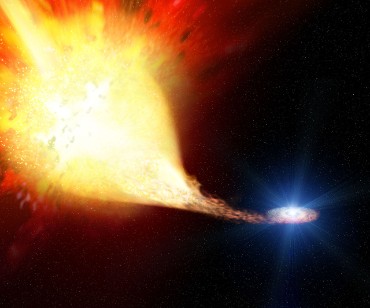
 New observations with the Hubble Space Telescope allow a look into a supernova explosion under development. In this artist's view the red supergiant supernova progenitor star (left) is exploding after having transferred about 10 solar masses of hydrogen gas to the blue companion star (right). This interaction process happened over about 250 years and affected the supernova explosion to such an extent that SN 1993J was later known as one of the most peculiar supernovae ever seen. | 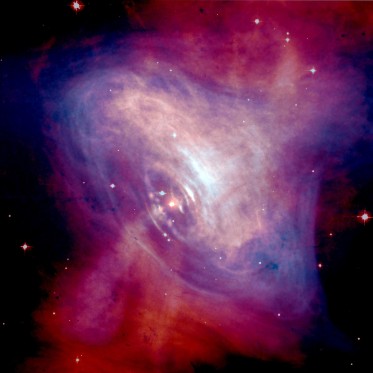 Just when it seemed like the summer movie season had ended, two of NASA's Great Observatories have produced their own action movie. Multiple observations made over several months with NASA's Chandra X-ray Observatory and the Hubble Space Telescope captured the spectacle of matter and antimatter propelled to near the speed of light by the Crab pulsar, a rapidly rotating neutron star the size of Manhattan. |
